It's that time again folks... Bolivia update... Again, where to start?
Leaving Salta, Argentina for Sucre, Bolivia was quite an adventure... I knew that it would be a long trip; including border crossing it was 26 hours- and although Salta and Sucre are nearly equidistant from the border, I spent more than two thirds that time in Bolivia. Villazon is the border town in Bolivia, imagine Tiajuana- but dirtier and less developed. Border crossing was crazy, my Spanish was much improved but still not great, which made things a bit more difficult- but the worst was yet to come. I had heard over and over that the buses in Bolivia were crazy, dirty and unreliable, so I was prepared when we got three flat tires and and broke down two more times besides. What I wasn't prepared for was the cold in the dead of night, on a bus that let in not only the below freezing air (-5 c) but the dirt kicked up by a bus speeding through eight hours of open land- no roads...
Let's just say that it took me a few days to recover from the exhaustion, cold and stress of that first day.
So- Bolivian buses: all but one I've been on (of maybe five or six) has broken down at least once- usually more than that. Most often, though, they fix them there on the side of the road, only a slight delay is incurred. A few times, however, the bus cannot be repaired so easily, and it becomes necessary to either sleep on or perhaps attempt to push start, one's bus. Unfortunately for me, both of those instances occurred on the same trip, and a ten hour ride became 21. Lesson: don't bother paying more for what you think is a more comfortable bus- it will likely still break down, and the one they send for you wont be as nice as the one for which you paid.
Roads in Bolivia- practically non existent. The major cities tend to be paved, or cobble stones, but most roads connecting from place to place are dirt, more like a track or path than road. It makes for some fun off-roading though, and for me, wasn't a huge concern. I learned real quickly not to have expectations, and to dress warmly- and everything works out-eventually. For some reason, though, most travellers are too high-maintenance and do nothing but bitch the whole time... I can't help but wonder why the hell they came to Bolivia...
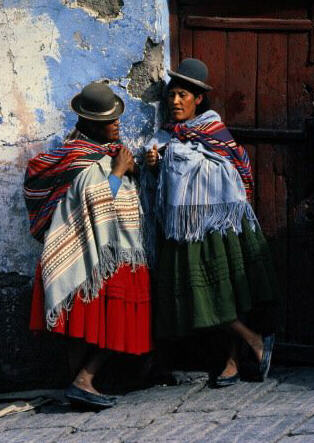
The cities in Bolivia have a strange contrast between traditional culture and modernity. In Sucre, a chill town where many come to study Spanish, you are just as likely to see a Chola, a traditional Bolivian woman, as you are a woman dressed in jeans and sweater. Though there aren't as many horse-drawn carts as there are in Uruguay- the duality is visible in the infrastructure as well as the social infrastructure; adobe houses can be seen next to high-rise buildings.
What else to say... Protests are as common as parades, both of which happen at least on a weekly basis. The protests are often about worker's grievances, often causing strikes and road blocks.
People not only piss, but defecate on the streets- which is almost understandable if you've seen their restrooms, which one has to pay to use, and which may or may not include a small child handing you a portion of toilet paper (one should always carry toilet paper on them).
Pharmacies have just about any pill you could ever want or need sold over the counter- but should you try and find some tape for a sports injury- you're out of luck. (For my family freaking out right now, the strongest thing I received was codine, and that was by chance: I went in and in Spanish, explained how I had bad knees, and at this altitude they really hurt, and when I googled what it was I had bought, I found it to be codine.)
Grocery stores are few and far between, but so are refrigerators, so it's not terribly surprising. You can buy just about anything you want- from shampoo to dinner- from street vendors, usually manned by cholas and small children.
Cocoa leaves and San Pedro (a cactus similar to Peyote) grow in abundance here in Bolivia. Natives chew cocoa leaves and drink the tea, which is said to relieve minor headaches and help cure altitude sickness. San Pedro can be purchased at the witch's market, legally, along with incense and llama skeletons (which they bury under a new dwelling for luck).
What have I been doing? I chilled out for about a week in Sucre, and excellent city for chilling and catching your breath. From there I went to Potosi, the highest city in the world, where over eight million miners have died in what has been the most profitable gold mine of all time. I happened to be at the mine during one of the three weeks a year that miners sacrifice llamas to the devil-god Tio, in hopes that he wont take another life within the mines.
Afterwards, I headed down to Tupiza to take a four day, three night tour of the national park and salt flats in the South West of Bolivia. From Uyuni I came to La Paz, the Capital of Bolivia, where I ended up working at Loki Hostel as a bar tender. The job came with free accommodations and two free meals a day, as well as 40% off everything, and discounts at most of the other restaurants, hostels, bars and clubs in town as well. With Loki as my home base, I took a day trip to the ruins at Tiwanaku (although, the difference between the rebuilt clay ruins and adobe homes of Bolivia is so slight, that whenever we see the remnants of an adobe home, we cry out, 'look- ruins!'). I also took a week off to get some fresh air and warmth in the low-lands and visit the Pampas of the Amazon, where I pet an alligator and acted as the translator for my group. Good times.
Soon I will be headed to Peru to climb Machu Pichu. On the way I'll stop by Lake Titicaca to see the ruins on Isla del Sol and Isla de la Luna.
I updated my online photo album- it's more complete than facebook, but also has a lot of photos that I would skip when posting on FB.




No comments:
Post a Comment